Alexa, Sarah Margaret, and I have combined our progressive topics to form a thesis.
Alexa- electric chair
Sarah Margaret- Brooklyn Bridge
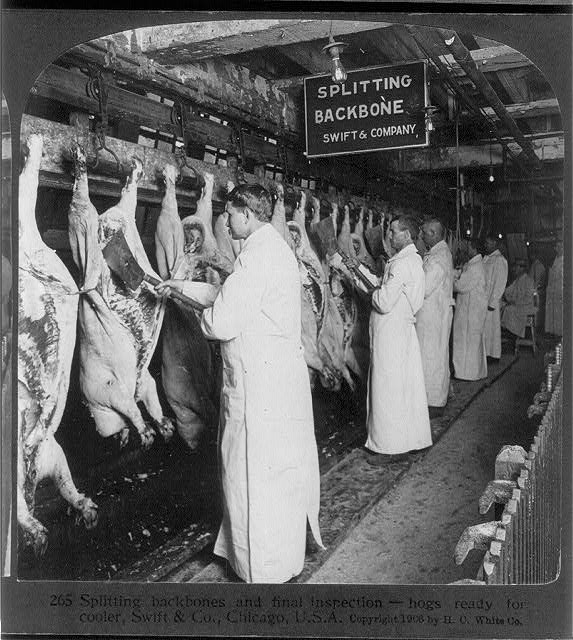
Cameron- "The Jungle" and Pure Food Laws
Thesis: "The Jungle" by Upton Sinclair (focusing on pure food laws), the Brooklyn Bridge, and the electric chair, while very different, all have the intentions of moving forward, improving life, and increasing efficiency during the Progressive era.
Conclusion: Pure food laws were created after "The Jungle" exposed the horrible conditions of the meatpacking industry, which attracted publicity and investigations of all food industries. The Brooklyn Bridge created a large, new, and efficient way of transportation in the city. The electric chair began to be used as a form of execution because it was thought to be a quick and relatively painless death and created a more effective and efficient way to deal with criminals. All of these progressive reforms are connected by their goal to improve efficiency and life of the people.
Friday, February 26, 2016

Monday, February 22, 2016
Progressivism: Overall Thesis
This blog is a thesis of the four ideas of progressivism our class came up with.
1. New expectations for government to act like a referee in society, promoting fairness
2. People solved problems, but their solutions also sometimes created new ones.
3. People looked to government to protect physical health and wellbeing from many modern threats.
4. Improve society and move forward to improve people's mind/health/lifestyle.
Thesis: The people of the progressive era encouraged improvement of health, lifestyle, and societal fairness by the referee-styled involvement of the government as well as society. The people looked to the government as a source of change for the better.
1. New expectations for government to act like a referee in society, promoting fairness
2. People solved problems, but their solutions also sometimes created new ones.
3. People looked to government to protect physical health and wellbeing from many modern threats.
4. Improve society and move forward to improve people's mind/health/lifestyle.
Thesis: The people of the progressive era encouraged improvement of health, lifestyle, and societal fairness by the referee-styled involvement of the government as well as society. The people looked to the government as a source of change for the better.
Multiple Choice Questions: Progressivism
1. All of the following are examples of progressivism EXCEPT:
a) The passage of the pure food bill and limitation of adulterated food.
b) Keating-Owen and Smith-Lever Acts on child labor.
c) The restriction of Roosevelt's authority over public lands by the conservatives in Congress, as well as limitation of government involvement.
d) The implication of the 18th and 19th Amendments.
e) Improvement of health quality of society.
2. Which of the following is NOT true about the time surrounding Roosevelt's time of absence?
a) He was on a brief hunting safari in Africa and an extended tour of Europe.
b) He remained a formidable presence to the American public.
c) His return was a large event in the spring.
d) Roosevelt announced his plan for a national speaking tour before summer's end.
e) He was livid with Taft and felt as if he could bring the reunite the Republican Party.
3. Which of the following was NOT a Republican progressive reformer?
a) Theodore Roosevelt
b) William Howard Taft
c) Woodrow Wilson
d) Senator Robert La Follette
e) Alice Paul
a) The passage of the pure food bill and limitation of adulterated food.
b) Keating-Owen and Smith-Lever Acts on child labor.
c) The restriction of Roosevelt's authority over public lands by the conservatives in Congress, as well as limitation of government involvement.
d) The implication of the 18th and 19th Amendments.
e) Improvement of health quality of society.
2. Which of the following is NOT true about the time surrounding Roosevelt's time of absence?
a) He was on a brief hunting safari in Africa and an extended tour of Europe.
b) He remained a formidable presence to the American public.
c) His return was a large event in the spring.
d) Roosevelt announced his plan for a national speaking tour before summer's end.
e) He was livid with Taft and felt as if he could bring the reunite the Republican Party.
3. Which of the following was NOT a Republican progressive reformer?
a) Theodore Roosevelt
b) William Howard Taft
c) Woodrow Wilson
d) Senator Robert La Follette
e) Alice Paul
Wednesday, February 17, 2016
Progressivism: "The Jungle" & Pure Food Laws
Throughout my research, I was able to learn, discover, and understand several ideas about the issue of food purity by examining primary source evidence in the newspaper archive. Upton Sinclair wrote "The Jungle", a book exposing the disturbing truth behind Chicago's meatpacking industry. Not only were the meatpacking plants filthy and polluted, but the meat contained feces, flesh of workers who were injured on the job, as well as rats. This gave the public a new insight on what was going into their food, which obviously, was disturbing. Instead of blaming the meatpacking industry for their unacceptable products and conditions, Theodore Roosevelt aimed his negative feedback towards Sinclair for taking his investigative research too far. This resulted in bad publicity towards the meatpacking industry which was not good for their business. According to the Albuquerque Journal, the bill setting pure food standards was passed on June 28, 1906. Although Sinclair's book ended up on the banned book list for some time, he still became known as the Father of Consumer Protection. The idea of pure foods relates to Progressivism by the fact that there was a need for improvement. Even though the meatpacking industry got negative publicity, it forced change and led the public to be aware. If we're being honest, who wants to eat meat consisting of human and rat remains much less feces!? Sinclair's negative feedback from Roosevelt, while unfortunate for him, caused the change he was looking for. Progressivism is the search for change and improvement in a society, government, ect. Sinclair's exposure of meatpacking industries made the public aware of what they were buying and consuming leading to the investigation of other food industries, other than just meatpacking. By passing the bill for pure food, a positive change took place, which is definitely an example of Progressivism. This had a lasting effect on the country as shown by the dates of the newspapers ranging from 1906 all the way to 1968, not to mention purity of food is still relevant today.
- Horrors in Chicago: Inside the Packing House
- March 12, 1906
- Dallas Morning News
- Sinclair: Father of Consumer Protection
- November 29, 1968
- Trenton Evening Times
- No More Dog Meat
- August 4, 1906
- Oregonian
- Bill Ready For Passage: Complete Agreement Reported by Conferees
- June 28, 1906
- Albuquerque Journal
- Cartoon: Pure Food and the "Big Stick"--"Well Mounted"
- June 6, 1906
- Bellingham Herald
 |
| Pure Food Political Cartoon |

 |
| Meat Inspection 1906 |
 |
| Upton Sinclair's "The Jungle" |

Wednesday, February 10, 2016
3rd Quarter Reflection
This quarter I have improved a lot in my analytical skills as well as reading and studying techniques. I got a 77 and a 79 on my tests first semester and a 98 on my test from second. I have started to understand what the reading is saying rather than just memorizing words. I hope to continue getting high grades on my tests. Going over movies in this class has been very beneficial because we have talked about a few different types of movies this year. I have used these skills outside of class as well as in other classes. My goal is to end the quarter and semester with an A. I hope to continue to improve all the skills I have been working on this year in US History. I feel like I have a better understanding of our country especially since this is my first time taking a US History class.
Skills/ Ideas:
-political cartoon analysis
-documentary dissection (topic, focus, angle)
-cultures
-imperialism
-phrenology
-progressivism
-reading comprehension (attention to details)
-going deeper into texts and movies
Skills/ Ideas:
-political cartoon analysis
-documentary dissection (topic, focus, angle)
-cultures
-imperialism
-phrenology
-progressivism
-reading comprehension (attention to details)
-going deeper into texts and movies
Tuesday, February 2, 2016
Thinking About Progress
1. To me, progress is any type of improvement from where one started, or movement closer to a goal.
2. The Progressive Era was a period of widespread social activism and political reform across the United States, from the 1890s to 1920s. It was referred to as the progressive era due to actions being taken to move the United States forward.
3. Several issues taken into consideration during this time were: female suffrage, education, working conditions, unionization, the problems of urbanization, industrialization and child labor. Achievements of this time included: 1887 Interstate Commerce Commission (ICC), protection of public health/welfare, prohibition of monopolies (anti-trust legislation), regulation of big businesses and corporations, important industry unionization, environment protection, 17th, 18th, and 19th Amendments.
4. Progressive reforms seemed to have the commonalities that they wanted equality and safety. They do not appear to be fans of the idea of some companies being higher up than others in an industry.
5. Goals good to bad:
2. The Progressive Era was a period of widespread social activism and political reform across the United States, from the 1890s to 1920s. It was referred to as the progressive era due to actions being taken to move the United States forward.
3. Several issues taken into consideration during this time were: female suffrage, education, working conditions, unionization, the problems of urbanization, industrialization and child labor. Achievements of this time included: 1887 Interstate Commerce Commission (ICC), protection of public health/welfare, prohibition of monopolies (anti-trust legislation), regulation of big businesses and corporations, important industry unionization, environment protection, 17th, 18th, and 19th Amendments.
4. Progressive reforms seemed to have the commonalities that they wanted equality and safety. They do not appear to be fans of the idea of some companies being higher up than others in an industry.
5. Goals good to bad:
- create health and safety codes
- conserve/protect natural resources, American lifestyle/living/working condition improvement, bring attention social injustices, inequality, child labor, the effects of illiteracy/alcohol abuse/crime, political reform
- prevent political machine bribery/corruption, "conviction that government must play a role to solve social problems and establish fairness in economic matters"
- control/regulate trusts/big businesses/corporations
Subscribe to:
Comments (Atom)