Monday, May 9, 2016

Climate: Actions Essay

Dear Reader,

It is May of 2016 and these days, our changing climate is causing several issues our generation is concerned about, such as, economic loss, changing landscapes, air pollution, heat and water related illnesses, extreme events, vector-borne diseases, mental health issues, and food safety and nutrition concerns. The United Nations (1), as well as several advocates, have come up with lists of actions for people of this time can take that will hopefully reduce the speed of climate change, as it is such a concern for us.

Our health is at risk with the changing climate at this time. Global Change's Health 2016 (2) refers to climate change affecting our health, "creates unprecedented or unanticipated health problems or health threats in places where they haven't previously occurred". We feel that by conserving energy, keeping your engines tuned properly, composting, using environment safe products, and using gas logs versus wood, we can reduce air pollution, improve air quality, which will hopefully reduce health issues caused by our changing climate. Steps  to be mindful of with rising temperatures and heat related illnesses include, drinking lots of water, replacing salts and minerals, wearing sunscreen and appropriate clothing, scheduling outside activities consciously, pacing yourself, monitoring of those at risk, and being mindful of the situation. Vector-borne diseases are becoming more prevalent for us with rising temperatures and unclean water. Actions being taken against these diseases, mentioned by The World Health Organization (3), are use of vaccines, informing others of diseases and how to treat them, training and technical support, having the tools and technology needed, and overall, knowledge of the diseases.

According to The Nature Conservancy (4), Green Balance (5), and the United Nations (1), some actions our community can and should take to help our climate, include: buy goods that use light packaging, reduce energy consumption, reuse, recycle, fix air leaks to increase energy efficiency, adjust thermostats according to the temperature outside, use energy efficient appliances, use power strips so they can be turned off when not in use, avoid using hot water for washing machines and dishwashers, improve city layout, improve public transport and rail freight, use of electric vehicles and renewable energies (biofuel, wind turbines, solar heat panels, solar photovoltaic panels, and geothermal energy), store CO2 underground, develop nuclear energy, eating less meat, poultry, and fish, plant trees, reduce printing usage, use reusable utensils, limit travel, reduce carbon footprint by walking or biking versus driving, and plenty others.

Our concerns in 2016 have a large range, one of which is mentioned by The Nature Conservancy (4) which says, "with rapid climate change, one-fourth of the Earth's species could be headed for extinction by 2050". Hearing that is scary to me because that means that some animals I have known of my whole life may not even be here by the time you're reading this. One-fourth of the Earth's species is a very high amount, so it is important for us to be conscious of our climate and how it is changing so that you will be able to enjoy the species we have now in 2016. Global Change's Health 2016 (2) also says, "with climate change, the frequency, severity, duration, and location of weather and climate phenomena--like rising temperatures, heavy rains and droughts, and some other kinds of severe weather--are changing".

Although there are endless ways for us to help avoid and reverse climate change, the biggest is to make others aware of what is happening so that by the time you are reading this letter, you will be able to experience a better climate than we are today. The only way to make a difference is if everyone is involved in making a positive change. Being aware, able to adapt, thinking green, and spreading the word about changing climate are the most important actions to take against it. If everyone steps up and is committed to making a difference, we have a chance to have a better climate in our future, your present, and preserving wildlife for your generation.

Footnotes: 
  1. The United Nations' website which lists actions to take, advised by the UN, to limit climate change.
  2. Global Change's Health 2016- a United States Global Change Research Program which gives a climate and health assessment in a report
  3. The World Health Organization- a global organization dedicated to the health of others
  4. The Nature Conservancy- "the leading conservation organization working around the world to protect ecologically important lands and waters for nature and people."
  5. Green Balance- an informal advocate association created by two individuals concerned about the climate.


Sources Used for Background Knowledge and My Understanding:

Monday, May 2, 2016

Climate Research


So far in my research, I have found several lists of actions to take to avoid climate change as well as what to do about the change in climate. I still want to know why climate change needs actions to be taken on its behalf and if all climate change is necessarily bad or not. The UN has made a list of actions to be taken to avoid climate change in several different areas. Global warming was brought up on the Green Balance website as an issue of climate change, as well as how to handle it. 

I would like to find out more background on climate change and why it is a negative, in order to connect it to the actions being taken. The sources I've used show actions that can be taken on several different levels of the community.

Thursday, April 28, 2016

Climate Research Option

I am most interested in the Action or Concern section because it would be most useful for the future.

Wednesday, April 27, 2016

Climate Questions

abbie
abby
alexa
sarah margaret
patrick

Are humans to blame for the drastic changes in the climate?
Is climate predictable?
Who is to "blame" those who created climate issues, or those stood by?
How will global warming affect us in the future?
What will the long term effects of climate/climate change be?

Monday, April 25, 2016

Climate

Sahara
Weather
Tundra
Humidity
Arctic

These words came to mind because in one of my elementary school classes, there was a poster on the wall with the climate zones and tundra, sahara, and arctic came to mind. When I think of climate, I also think of the weather which caused me to think humidity.

Are animals or humans more affected by climate change?

Wednesday, April 13, 2016

The New Era: Modernism vs. Traditionalism

The 1920s, also known as the New Era, was a time of transition from traditional to modern. While some embraced the change, others resisted, and some even fought to hold on to traditional values. The economy, culture, religion, and nativism all experienced the incorporation of modernistic ideas. The biggest conflict in the 1920s was modernism versus traditionalism.

The economy of the 1920 was full of great improvements with little objection. The working conditions improved, women were finally allowed to have jobs outside the house, and people began to have access to more luxuries and "wants" rather than only essentials or "needs", because of the new technologies and inventions. Although women were not yet considered equal to men, they were allowed to work in "feminine fields". Most married women continued to work at home, but women who chose to work, were part of the working class. The New Era introduced radios, home appliances, automobiles, cars, as well as several other luxury items.

One of the most distinctive developments of this era was introduced as the Youth Culture. Teenagers gained their own title because it is a vital time in one's life. The importance of education increased tremendously. The "Lost Generation" was composed of artists and intellectuals who disliked America's obsession with material success. Literature and art became prominent having some of the most renowned authors of all time, such as F. Scott Fitzgerald, Ernest Hemingway, along with others.

Religion began to play into other views such as modernism and traditionalism. Traditionalists became known as Religious Fundamentalists. They disliked the change and abandonment of traditions the modernists promoted. Women began to be examples of this as well by the introduction a new standard. Flappers, shorter dresses, drinking, smoking, and partying all became part of women's culture. Some chose to embrace the change while others stuck to their traditional roles.

Some took the preservation of culture and traditions to extremes, one group in particular, the Ku Klux Klan. Their goal was to keep America pure and traditional by eliminating what they felt were alien influences: Catholics, blacks, Jews, and foreigners. Their focus after the Klan's revival shifted from blacks to Catholics, Jews, foreigners, as well as anyone who challenged traditional values, white Protestants guilty of irreligion, sexual promiscuity, or drunkenness. The Klan eventually declined shortly after 1925. On the other end of the spectrum, African Americans introduced jazz music and created the Harlem Renaissance with the goal to preserve and share their racial heritage.

The 1920s was full of significant aspects, change, and conflicting ideas. Despite the traditionalists persistently resisted change, this era is known for its racy and modernistic ideas.


1930s Radio: Advertising

The radio business began airing advertisements during the time of the Great Depression due to the need for job opportunities. Several businesses who utilized the radio for advertising were: Camel cigarettes, General Mills, General Motors Corp, General Food Corp., Oscar Meyer, along with lots of others. Pretty much any and every type of business used the radio to advertise. More options began to be available, and with that came ratings. The early 30s were mainly advertising products and companies, but by the late 30s, the radio began advertising entertainment, scandals, and sports. Even TV shows began advertising on the radio for upcoming episodes. Several products that were consistently advertised were: soap, jello, over the counter medications.
1930s Radio Ads
Radio ad replays


Wednesday, April 6, 2016

Pocket Book Reviews

Sweet Talking & Speaking Easy- It is written like a story, but took a little while to get to the topic.

Tuesday, March 29, 2016

Language culture

Slang:
i cant
same
fr
ln
tn 
tm
rn
i mean bye
dead
idk
idek
selfie
swag
swerve


Discourse Modifiers:
like
really
just
that

Pause Fillers:
um
uh
hmm
wait
ya um
ya so
so ya
so
yes?
right?
ok?

Vocal ticks:
yes? 
right?
ok?
umm/ uhh
ya know what i mean
looking above someones head while talking
lacking eye contact
playing w hair
inability to stand still

Wednesday, March 2, 2016

WWI Poster Analysis

1. I have heard the word propaganda before and have probably heard it on membean, but I do not remember the definition. If I had to guess, I would think it is a topic or issue that has been brought to the focus of a large audience.
2. Propaganda- information, ideas, or rumors widely spread to help or hurt a person, group, movement, ect.
4-6. The wording is persuasive; all very big and bold in font as well. The man in the first poster is in a naval uniform and smiling and "A wonderful opportunity for YOU" makes it seem like joining the navy is a benefit for the people in it rather than a sacrifice for our country. The art is less detailed and more cartoon like to make it more appealing by looking the part of an advertisement. The second poster uses less common wording so people may not fully understand what is being said, but is intrigued regardless. The picture shows power by having men stand around watching a giant cannon/gun shoot off. The art, while still fairly cartoon-like, is a little more detailed than the first. The third poster is most painting-like it appears the artist spent lots of time on it gaining appreciation from the viewers. It also shows a well dressed man being persuaded/convinced/guilted into joining the Navy by a sailor and an angel-like woman with a flag which seems to be showing the idea of it being our duty as Americans to defend our country. The facial expressions of the three people in the image all express very different emotions towards/about going into the navy. The business man- seriousness or pride; the sailor- concern or sternness; the angel- worry, fear, longing. The color choice in all three is bright and grabs the attention of viewers, as it should, being an advertisement or recruitment poster. The artists' assumptions of their audience is probably focused towards young men by attracting them with the smile, tank/guns, and patriotism. 
7. I don't think we need to waste money on advertisements when they could be brought up in other ways such as the news, magazines, or other ways.
8. 

Friday, February 26, 2016

Progressivism: Thesis and Conclusion

Alexa, Sarah Margaret, and I have combined our progressive topics to form a thesis.

Alexa- electric chair
Sarah Margaret- Brooklyn Bridge
Cameron- "The Jungle" and Pure Food Laws

Thesis: "The Jungle" by Upton Sinclair (focusing on pure food laws), the Brooklyn Bridge, and the electric chair, while very different, all have the intentions of moving forward, improving life, and increasing efficiency during the Progressive era.

Conclusion: Pure food laws were created after "The Jungle" exposed the horrible conditions of the meatpacking industry, which attracted publicity and investigations of all food industries. The Brooklyn Bridge created a large, new, and efficient way of transportation in the city. The electric chair began to be used as a form of execution because it was thought to be a quick and relatively painless death and created a more effective and efficient way to deal with criminals. All of these progressive reforms are connected by their goal to improve efficiency and life of the people.

Monday, February 22, 2016

Multiple Choice Questions: Progressivism (Key)

1. C
2. A
3. C

Progressivism: Overall Thesis

This blog is a thesis of the four ideas of progressivism our class came up with.

1. New expectations for government to act like a referee in society, promoting fairness
2. People solved problems, but their solutions also sometimes created new ones.
3. People looked to government to protect physical health and wellbeing from many modern threats.
4. Improve society and move forward to improve people's mind/health/lifestyle.

Thesis: The people of the progressive era encouraged improvement of health, lifestyle, and societal fairness by the referee-styled involvement of the government as well as society. The people looked to the government as a source of change for the better.

Multiple Choice Questions: Progressivism

1. All of the following are examples of progressivism EXCEPT:
a) The passage of the pure food bill and limitation of adulterated food.
b) Keating-Owen and Smith-Lever Acts on child labor.
c) The restriction of Roosevelt's authority over public lands by the conservatives in Congress, as well as limitation of government involvement.
d) The implication of the 18th and 19th Amendments.
e) Improvement of health quality of society.

2. Which of the following is NOT true about the time surrounding Roosevelt's time of absence?
a) He was on a brief hunting safari in Africa and an extended tour of Europe.
b) He remained a formidable presence to the American public.
c) His return was a large event in the spring.
d) Roosevelt announced his plan for a national speaking tour before summer's end.
e) He was livid with Taft and felt as if he could bring the reunite the Republican Party.

3. Which of the following was NOT a Republican progressive reformer?
a) Theodore Roosevelt
b) William Howard Taft
c) Woodrow Wilson
d) Senator Robert La Follette
e) Alice Paul

Wednesday, February 17, 2016

Progressivism: "The Jungle" & Pure Food Laws

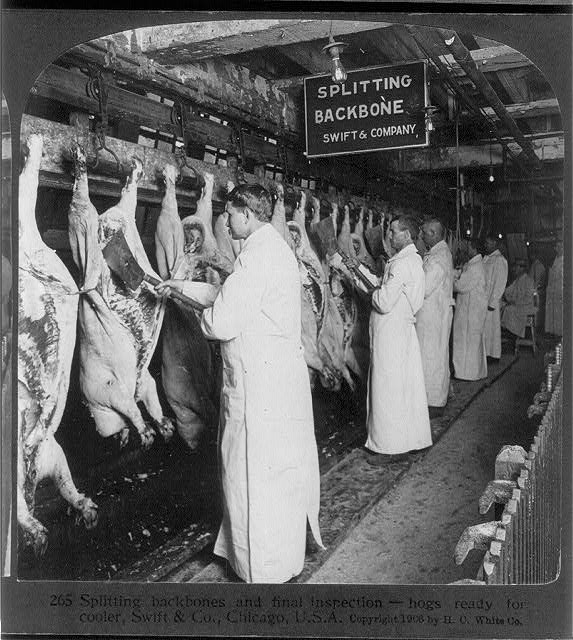
Throughout my research, I was able to learn, discover, and understand several ideas about the issue of food purity by examining primary source evidence in the newspaper archive. Upton Sinclair wrote "The Jungle",  a book exposing the disturbing truth behind Chicago's meatpacking industry. Not only were the meatpacking plants filthy and polluted, but the meat contained feces, flesh of workers who were injured on the job, as well as rats. This gave the public a new insight on what was going into their food, which obviously, was disturbing. Instead of blaming the meatpacking industry for their unacceptable products and conditions, Theodore Roosevelt aimed his negative feedback towards Sinclair for taking his investigative research too far. This resulted in bad publicity towards the meatpacking industry which was not good for their business. According to the Albuquerque Journal, the bill setting pure food standards was passed on June 28, 1906. Although Sinclair's book ended up on the banned book list for some time, he still became known as the Father of Consumer Protection. The idea of pure foods relates to Progressivism by the fact that there was a need for improvement. Even though the meatpacking industry got negative publicity, it forced change and led the public to be aware. If we're being honest, who wants to eat meat consisting of human and rat remains much less feces!? Sinclair's negative feedback from Roosevelt, while unfortunate for him, caused the change he was looking for. Progressivism is the search for change and improvement in a society, government, ect. Sinclair's exposure of meatpacking industries made the public aware of what they were buying and consuming leading to the investigation of other food industries, other than just meatpacking. By passing the bill for pure food, a positive change took place, which is definitely an example of Progressivism. This had a lasting effect on the country as shown by the dates of the newspapers ranging from 1906 all the way to 1968, not to mention purity of food is still relevant today.


  • Horrors in Chicago: Inside the Packing House
    • March 12, 1906
    • Dallas Morning News
  • Sinclair: Father of Consumer Protection 
    • November 29, 1968
    • Trenton Evening Times
  • No More Dog Meat
    • August 4, 1906
    • Oregonian
  • Bill Ready For Passage: Complete Agreement Reported by Conferees
    • June 28, 1906
    • Albuquerque Journal
  • Cartoon: Pure Food and the "Big Stick"--"Well Mounted"
    • June 6, 1906
    • Bellingham Herald
Pure Food Political Cartoon
Meat Inspection 1906
Upton Sinclair's "The Jungle"


Wednesday, February 10, 2016

3rd Quarter Reflection

This quarter I have improved a lot in my analytical skills as well as reading and studying techniques. I got a 77 and a 79 on my tests first semester and a 98 on my test from second. I have started to understand what the reading is saying rather than just memorizing words. I hope to continue getting high grades on my tests. Going over movies in this class has been very beneficial because we have talked about a few different types of movies this year. I have used these skills outside of class as well as in other classes. My goal is to end the quarter and semester with an A. I hope to continue to improve all the skills I have been working on this year in US History. I feel like I have a better understanding of our country especially since this is my first time taking a US History class.

Skills/ Ideas:
-political cartoon analysis
-documentary dissection (topic, focus, angle)
-cultures
-imperialism
-phrenology
-progressivism
-reading comprehension (attention to details)
-going deeper into texts and movies

Tuesday, February 2, 2016

Thinking About Progress

1. To me, progress is any type of improvement from where one started, or movement closer to a goal.
2. The Progressive Era was a period of widespread social activism and political reform across the United States, from the 1890s to 1920s. It was referred to as the progressive era due to actions being taken to move the United States forward. 
3. Several issues taken into consideration during this time were: female suffrage, education, working conditions, unionization, the problems of urbanization, industrialization and child labor. Achievements of this time included: 1887 Interstate Commerce Commission (ICC), protection of public health/welfare, prohibition of monopolies (anti-trust legislation), regulation of big businesses and corporations, important industry unionization, environment protection, 17th, 18th, and 19th Amendments.
4. Progressive reforms seemed to have the commonalities that they wanted equality and safety. They do not appear to be fans of the idea of some companies being higher up than others in an industry.
5. Goals good to bad:

  1. create health and safety codes
  2. conserve/protect natural resources, American lifestyle/living/working condition improvement, bring attention social injustices, inequality, child labor, the effects of illiteracy/alcohol abuse/crime, political reform
  3. prevent political machine bribery/corruption, "conviction that government must play a role to solve social problems and establish fairness in economic matters"
  4. control/regulate trusts/big businesses/corporations


Thursday, January 21, 2016

How Do You Analyze a Political Cartoon?

Before research, I analyzed political cartoons by what they are showing and how it made me feel about the topic portrayed. I never had a guide to go by, but after finding one from the Library of Congress, I learned the key ideas to pay attention to: symbolism, exaggeration, labeling, analogy, and irony. In the future I will look to this guide as I analyze political cartoons. This guide helps to understand the underlying meaning of the cartoon in a way that is appealing to the audiences.
McKinley and the Philippines
This cartoon shows Spain as a deep dark place, McKinley/the US as in control of the Philippines which is shown as a young, dark-skinned, poor-looking boy, and the rest of the world as an over looker of the situation.
Cuba as suffering mother
I view this cartoon as Cuba being the grandmother of an ill or dying son as the country of Cuba with the eagle as the US in the background preying on the nearly "dead" Cuba.
Spain after loss of Philippines
This cartoon is showing the Spanish returning home after losing the Philippines. They appear to be sad or confused looking.


Friday, January 15, 2016

Hawaiian: The Legend of Eddie Aikau

I think the film was called Hawaiian: The Legend of Eddie Aikau because the film shows that Eddie Aikau is the definition of a true Hawaiian, not only by his exceptional surfing abilities, but also by his devotion to protecting his family and preserving Hawaiian culture. This film was made by ESPN which led the film to portray the idea that sports, such as surfing, are much more than an activity--a passion, lifestyle, and culture. The filmmakers probably wanted their audiences to be exposed to the deeper background of sports. If a history channel had made this film, the extent of surfing covered would probably be less and more focused on the history of the culture and characters.

Topic: Imperialism
Focus: The reality and goals of Imperialism in America.
Angle: Some Americans accepted imperialism not in support, but in the hopes remaining independent.

Thursday, January 7, 2016

Phrenology

Today I was late to class, so I missed the research period, but I was able to listen to the findings of my classmates. The L.N. Fowler Phrenology bust was a replica of the original busts which was shown by the bust being hollow as opposed to solid as the originals were. The phrenology bust that we had available to us today would be a secondary source because it was a replica, not an original, and it is not useful as a primary source to us in this situation. It lacks accuracy because the busts were created in the 19th century and since then, the study of the brain has been further analyzed and studied. The bottom of the replica bust said Oregon which told us it could be no older than 1859 because that's when Oregon became a state. The cracking in the glaze showed that it had not been made recently, but definitely was not an antique. I learned that a source can be primary or secondary based on the context in which it is being used. Although the information the phrenology bust provides is not completely accurate, some aspects are, such as: the idea that different portions of the brain control different functions.

Provenance- (noun) the place of origin or earliest known history of something; a record of ownership of a work of art or an antique, used as a guide to authenticity or quality; the beginning of something's existence; something's origin

Phrenology- (noun) the detailed study of the shape and size of the cranium as a supposed indication of character and mental abilities